Emerson College exists as a particular kind of paradox. It is an institution physically anchored in the heart of Boston, a city steeped in American history, yet its true domain is the intangible landscape of human expression. It does not merely teach students about communication and the arts; it operates on the fundamental belief that these are the primary forces through which reality is shaped, contested, and understood. To walk through its urban campus is to witness a living laboratory where story is the central unit of measurement, and every sidewalk could be a stage, every brick wall a potential screen.
The college’s philosophy feels like a direct inheritance from its namesake, Ralph Waldo Emerson, though the connection is more spiritual than pedagogical. Emerson, the transcendentalist, championed self-reliance and the idea that insight comes from a profound connection with the natural world. The modern Emerson College translates this for an urban, mediated age. Its version of self-reliance is the creative voice, and its nature is the complex ecosystem of media, performance, and public discourse. The goal is not to escape society for contemplation, but to plunge into its noisy core and learn to project a clear, compelling signal.
This ethos manifests in a curriculum that is inherently kinetic. Classrooms are often workshops, studios, or control rooms. A student studying film does not simply analyze theory; they are handed a camera and sent into the city to capture a narrative. A playwright sees their words tested by actors in a black box theater before the ink is fully dry. The division between academic exercise and professional practice is deliberately thin, almost osmotic. This creates an environment where failure is not a setback but a necessary draft, a required iteration on the path to a finished, impactful piece of work.
The campus itself functions as a permeable membrane between the institution and the city. Emerson’s theaters host public performances, its galleries display student work for any passerby to see, and its journalism projects often engage directly with Bostonian communities. This lack of a traditional, isolated quadrangle is symbolic. There is no ivory tower here. The world is the laboratory, and the audience is not a hypothetical future entity but a present and immediate one. This constant engagement demands a certain resilience and authenticity from students, forcing their art to be robust enough to survive outside the supportive incubator of a closed campus.
Furthermore, Emerson’s focus has expanded beyond its renowned strengths in theater and writing to fully embrace the digital frontier. Its programs in digital media, marketing communication, and emerging media represent a recognition that the agora of human interaction has shifted. The stage is now also a Twitter feed; the pulpit is a YouTube channel; the town square is a complex algorithm on a social media platform. Students learn to craft messages not just for the proscenium arch or the printed page, but for the flickering, attention-starved screens that dominate contemporary life. They are taught to be architects of experience in a world saturated with information.
The outcome of this education is a specific type of graduate. They are not merely trained in a skill set, but wired with a particular sensibility. They are narrative engineers. They understand that power, culture, and change are all functions of the stories we tell ourselves. Whether they become documentary filmmakers uncovering truth, comedians refining timing and social commentary, or communication strategists shaping a brand’s identity, they share a common literacy. They speak the language of effect. They know how a cut can change emotion, how a sentence can build a world, how a performance can challenge a presumption.
In a world often criticized for being fragmented and noisy, Emerson College bets on coherence and clarity. It operates on the conviction that the most essential work is not necessarily in generating more content, but in generating meaning. It prepares its students to be the ones who can cut through the static, who can structure the chaos into a compelling narrative, and who understand that the most powerful technologies we possess are not made of silicon, but of story and sound and image. It is, in the end, less a college and more a command center for the cultivation of voice, training its students to go out and change the frequency of the world.
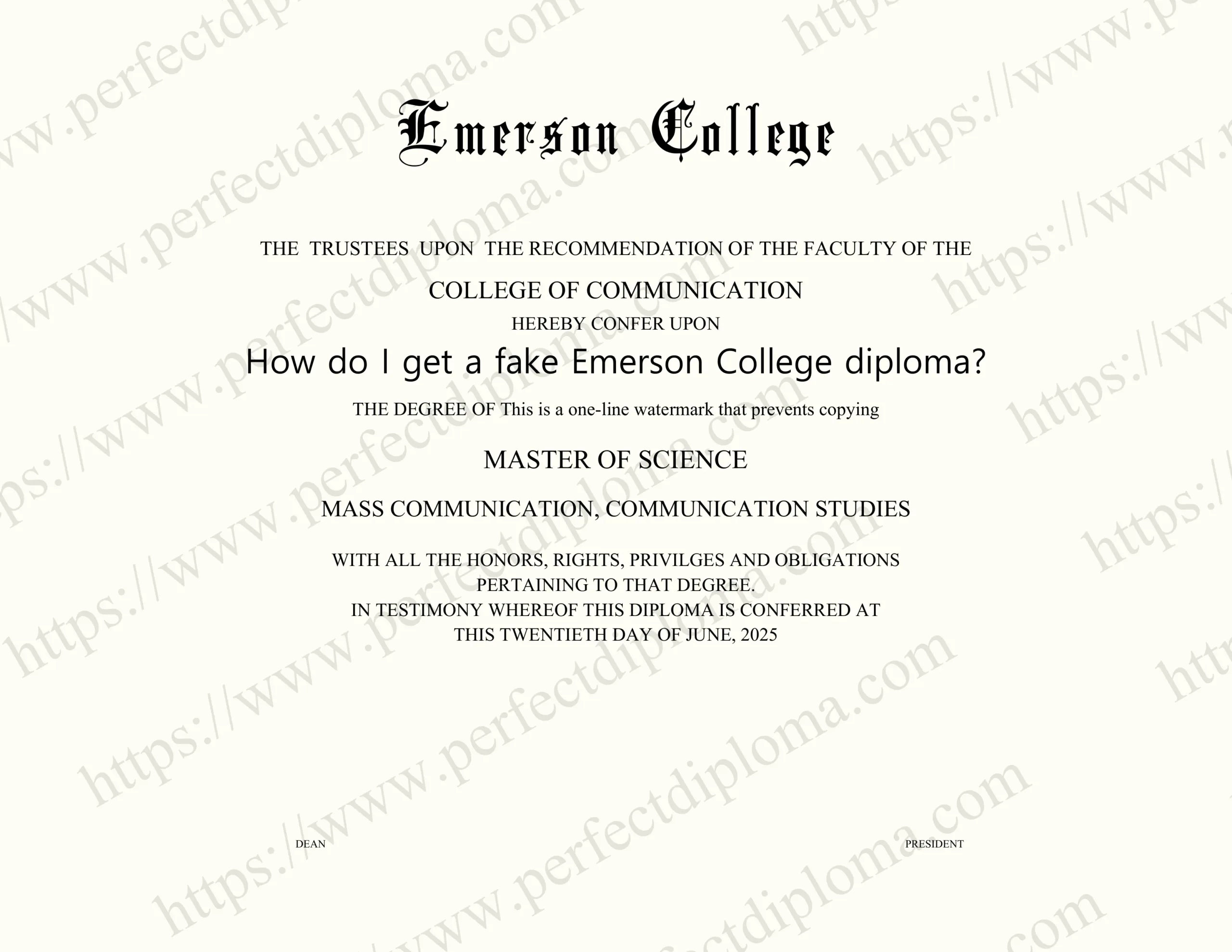
Steps to order Emerson College transcript online., Buy fake degree, Fake diploma online, Can I buy a fake Emerson College diploma?, Get Emerson College fake diploma, Buy fake certificate