California College of the Arts exists not as a solitary structure but as a distributed idea, a network of creative thought woven into the urban fabric of San Francisco and Oakland. To define it by its campuses or its curriculum is to miss its fundamental nature. This is an institution that treats the entire Bay Area as its studio, its laboratory, and its gallery.
The air here seems charged with a different kind of electricity, one composed of equal parts silicon and sawdust. Students are not merely taught skills; they are immersed in a methodology of making. This process begins with a question, not a command. A student in the Architecture division might start by examining the social dynamics of a public bus line, understanding movement and interaction as foundational elements before ever sketching a wall. A painter in the Fine Arts program could spend a semester studying the chemical decay of materials, viewing time as a collaborative medium. The act of creation is a form of rigorous inquiry, where the outcome is unknown and the journey itself is the education.
What makes CCA uniquely potent is its conscious erosion of the traditional boundaries between disciplines. This is not the polite, occasional collaboration found in many institutions. It is a deliberate, sometimes chaotic, intermingling of minds. You will find a glassblower working with a data scientist to physicalize network traffic into fragile, luminous forms. A fashion designer might partner with an industrial design student to create wearable technology that responds to environmental pollution levels. The studios are not segregated by major; they are crossroads where conversations about narrative structure from a writing student can fundamentally alter the approach of an animator. This constant cross-pollination produces hybrids, work that is difficult to classify but impossible to ignore.
The college operates with a profound awareness of its context. Situated in one of the most technologically saturated and socially complex regions on earth, it engages directly with the world outside its doors. The ethos of design thinking is applied not just to objects, but to systems, services, and social inequities. A graphic design project might focus on creating clear, accessible public health information for non-native speakers. A community arts project could involve co-designing a public park with local residents, translating their stories and needs into physical space. This is art and design as social practice, where aesthetic decisions are deeply entangled with ethical considerations and civic responsibility.
The faculty at CCA are not distant academics but practicing artists, designers, and writers who bring the urgency of their own studios into the classroom. They are guides who have navigated the treacherous and rewarding waters of a creative life. They speak of grant applications and creative block, of gallery relationships and client negotiations with the gritty authenticity of lived experience. Learning from someone who is currently wrestling with the same challenges demystifies the path from student to professional. It frames a creative career not as a fantasy, but as a viable, though demanding, way of being.
Perhaps the most significant lesson CCA imparts is a redefinition of failure. In an environment that prizes experimentation, a failed experiment is not a defeat; it is data. A collapsed ceramic form reveals the limits of its structure. A user-test of a new app interface that confuses people is a success in clarifying what not to do. The college cultivates a resilience that is essential for any sustainable creative practice. Students learn to detach their ego from a single outcome and instead invest in the integrity of their process. They build a portfolio not just of finished works, but of problems engaged, risks taken, and lessons learned.
Ultimately, California College of the Arts graduates more than just artists and designers. It graduates world-builders. These are individuals equipped with a rare combination of visionary thinking and pragmatic skill. They leave knowing how to shape clay, code, narrative, and social spaces. They understand that a chair, a website, a film, and a public policy are all things that can be designed, and that design carries consequence. They enter the world not waiting for an invitation, but ready to build new realities, to ask the next beautiful, necessary question, and to continue the work they began in that sprawling, idea-rich territory between San Francisco and Oakland.
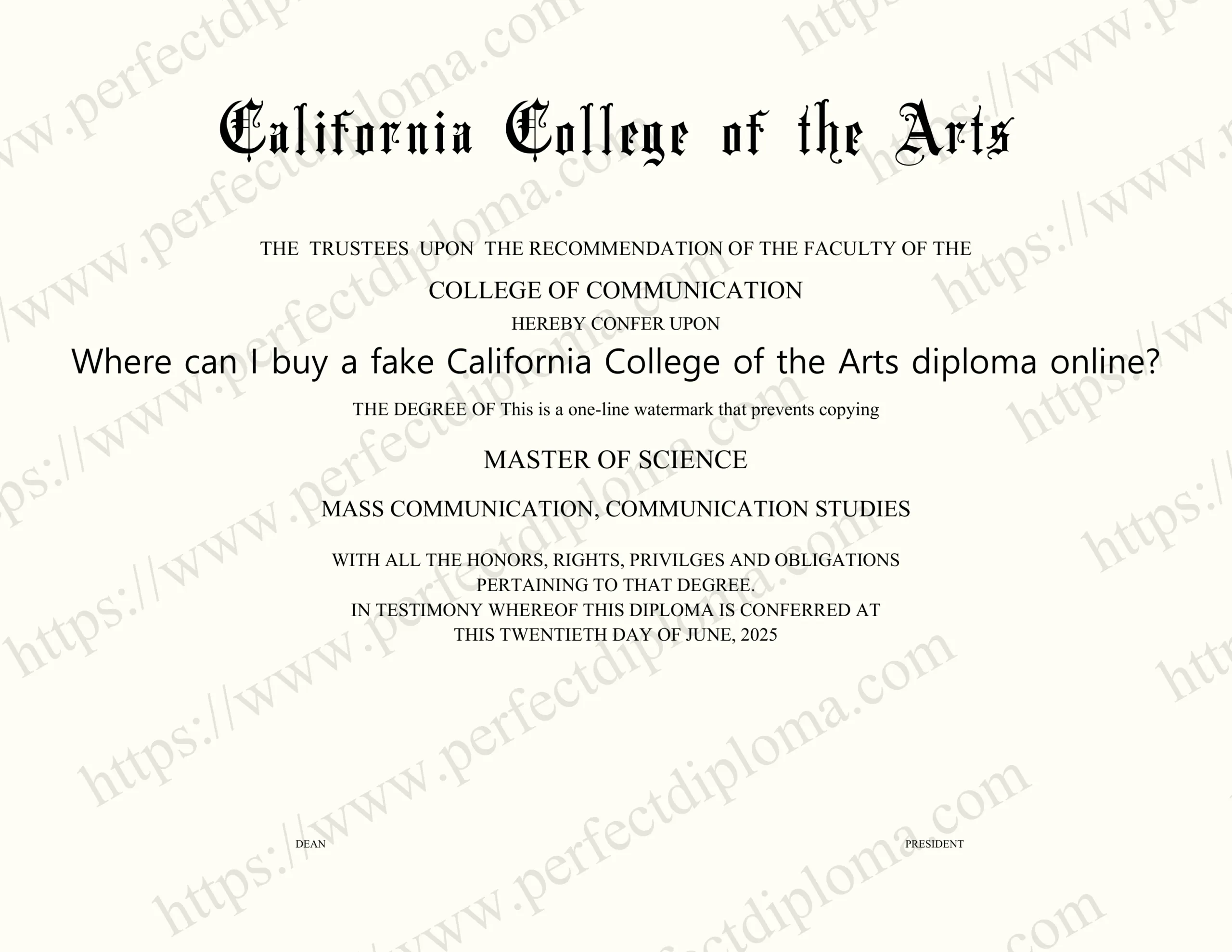
Buy a fake California College of the Arts diploma, Make California College of the Arts diploma online, Buy fake certificate in USA, Fake California College of the Arts degree online, Buy a fake California College of the Arts diploma online., Fake degree online