California State University Northridge exists as a remarkable paradox. It is not nestled within a quintessential college town, nor does it possess the ancient, ivy-covered walls of older institutions. Instead, it thrives in the vibrant, sometimes chaotic, heart of the San Fernando Valley, a vast and diverse suburb of Los Angeles. This very location is not just its address but the core of its identity, shaping an academic environment that is unapologetically real-world, pragmatic, and dynamically reflective of contemporary California.
The architecture of the campus tells its own story. The 1994 Northridge earthquake did not just damage buildings; it fundamentally altered the university’s physical landscape. The rebirth that followed replaced many older structures with modern, seismically resilient facilities. Walking through campus today, one encounters a blend of late-twentieth-century concrete brutalism and sleek, glass-paneled new builds. The Oviatt Library, with its iconic Delmar T. Oviatt Library, stands as a testament to this transformation, a symbol of resilience and forward momentum. This is not a campus frozen in time; it is one that has been forced to rebuild, to adapt, and in doing so, it has internalized these qualities as part of its educational philosophy.
Academically, CSUN operates on a scale that is almost difficult to comprehend. With one of the largest undergraduate populations in the entire nation, the university functions like a small city. The sheer breadth of its curriculum is staggering, from renowned film and television production programs that feed directly into the nearby Hollywood machine to a distinguished college of engineering and computer science that supplies talent to Southern California’s booming tech sector. The Mike Curb College of Arts, Media, and Communication pulses with creative energy, while the David Nazarian College of Business and Economics prepares a new generation of entrepreneurs and corporate leaders. This scale allows for a depth of specialization that smaller schools cannot match, creating a rich ecosystem of intellectual pursuit.
Yet, the true genius of CSUN lies not in its size, but in its profound commitment to accessibility and social mobility. It is a designated Hispanic-Serving Institution, a title that reflects a deep-seated mission rather than mere demographics. The student body is a microcosm of the global community, a tapestry of first-generation scholars, returning veterans, transfer students from local community colleges, and international pupils. This creates a learning environment where diverse perspectives are not an abstract ideal but a daily reality. The classroom discussions are inevitably richer, informed by a multitude of lived experiences that challenge and expand conventional viewpoints. Education here is understood as a powerful engine for personal and familial advancement.
Life outside the lecture halls is equally defined by this sprawling diversity. There is no single, monolithic student experience. Instead, campus life is a collection of countless overlapping communities. Hundreds of student-run clubs cater to every conceivable interest, from cultural associations and academic honor societies to groups focused on robotics, salsa dancing, or environmental activism. The University Student Union serves as a constant hive of activity, a crossroads where paths intersect and new connections are forged. Matadome, during a basketball game, becomes a rare unifying force, where the collective pride of being a Matador temporarily consolidates the vast student population into a single, roaring entity.
The relationship between CSUN and its surrounding community is symbiotic. The university does not exist as an isolated academic enclave; it is deeply woven into the fabric of the San Fernando Valley. Its students provide a vibrant workforce and consumer base for local businesses. Its faculty engage in applied research that addresses regional challenges, from public health to urban planning. Cultural events, concerts, and art exhibitions hosted by the university are open to the public, making it a vital cultural hub for the entire region. In return, the Valley provides a living laboratory, offering internships, clinical placements, and real-world projects that ground academic theory in practical application.
In conclusion, California State University Northridge defies the traditional, romanticized image of a university. It is not an ivory tower. It is a workshop, a launchpad, a vibrant and sometimes messy urban ecosystem dedicated to the democratization of opportunity. Its strength is derived from its resilience, its immense scale, and its unwavering dedication to serving the children of California in all their magnificent diversity. It is a place where dreams are not just imagined but constructed, piece by piece, through hard work, access to knowledge, and the powerful synergy of a community learning and growing together. It is, in every sense, the university of the real world.
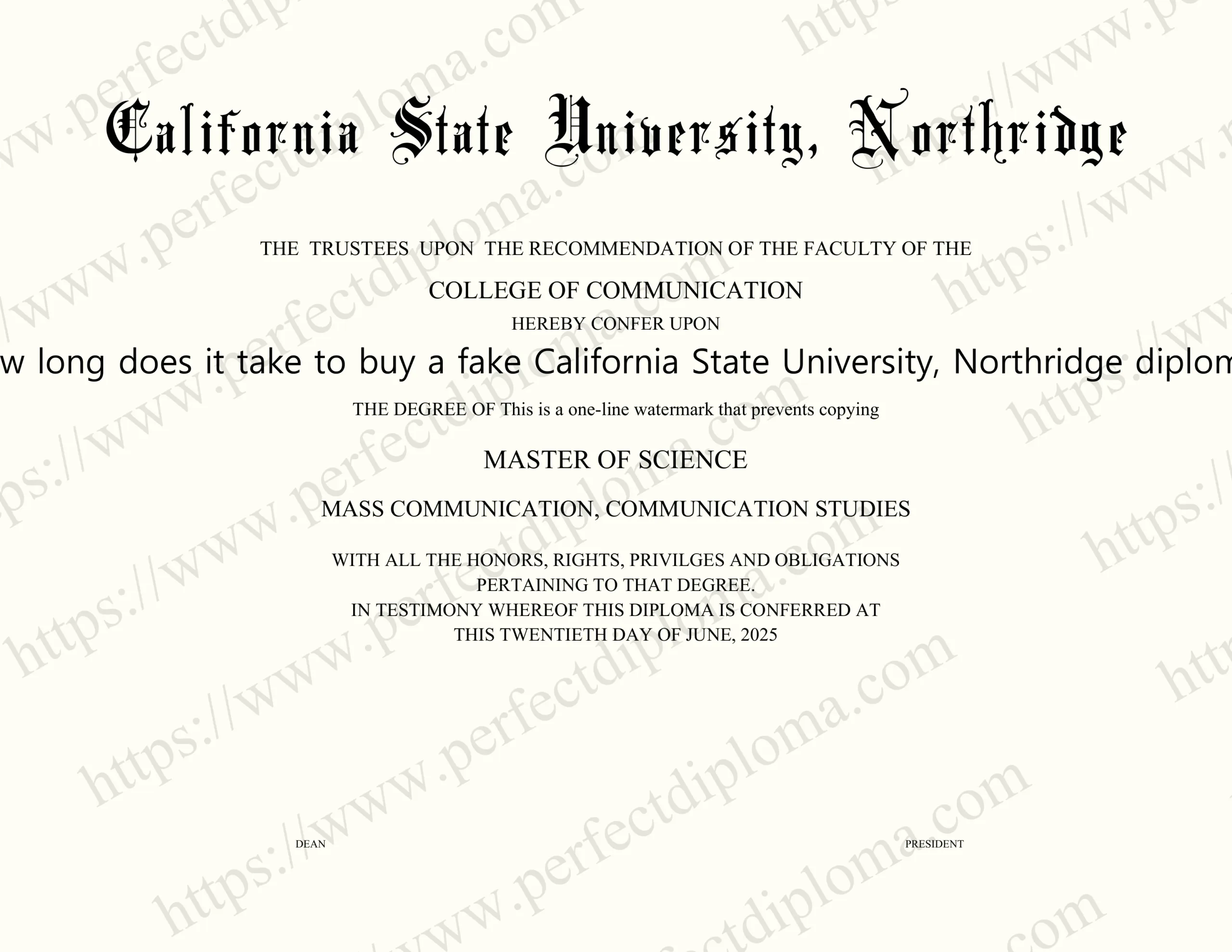
Can i get to buy California State University, Northridge fake degree?, Fake degree online, Buy fake degree, Fake diploma online, Where can i get to buy California State University, Northridge fake certificate