San Mateo College stands as a quiet testament to a particular kind of American promise. It is not the promise of ivy-covered walls or storied athletic legacies, but something more fundamental and, in its way, more radical. It is the promise of a second act, a recalibrated path, and an education that serves not as a destination, but as a deliberate, powerful launchpad.
Located in the heart of California’s dynamic San Francisco Peninsula, the college exists within a unique ecosystem of immense wealth and cutting-edge technology. Yet, its mission remains steadfastly grounded in accessibility. The students who traverse its campus are a mosaic of modern America. One sees a recent high school graduate, unsure of a four-year university’s financial burden, sitting beside a seasoned professional in her forties, seeking a new career in biotechnology. There is a veteran utilizing the GI Bill, a parent taking evening classes after work, and an immigrant mastering English while concurrently studying calculus. This convergence of lives and ambitions creates an academic atmosphere that is intensely practical and purpose-driven. The air hums not with the abstract debates of a secluded academy, but with the focused energy of people building a tangible future.
The curriculum itself is a reflection of this pragmatic idealism. While transfer pathways to prestigious University of California and California State University campuses form a critical artery of the institution, the college’s strength lies in its direct dialogue with the world beyond its borders. Classrooms and laboratories are equipped not just for theory, but for application. In a nursing simulation lab, students practice with mannequins that mimic human responses, their learning immediate and visceral. In computer science courses, the focus is on the programming languages and frameworks demanded by the tech giants and startups just a few miles north. The education here is consciously porous, allowing the needs of the community and the economy to flow directly into its syllabi.
This creates a fascinating dynamic where the college functions as both a sanctuary and a thoroughfare. It is a sanctuary for those who need a place to learn, to grow, and to redefine themselves away from the pressures of a traditional university timeline. The library is not just a repository of books, but a communal study space where collaborative projects bridge generations and cultures. The student commons buzz with conversations in a dozen languages, all centered on shared goals of completion and advancement. Yet, it is equally a thoroughfare, a channel through which people move with intention. There is little of the lingering, four-year exploration of a residential college; the pace is often brisk, the focus sharp. Students are not just learning who they are, but actively constructing who they will become, course by course, semester by semester.
Faculty at such an institution are less distant scholars and more like skilled architects and guides. Their primary role is to design learning experiences that are effective, accessible, and directly relevant. They understand that their students are often balancing multiple responsibilities, and their pedagogy is frequently adapted to meet this reality. Success is measured not in publications alone, but in the light of understanding in a student’s eyes, in the successful transfer to a university, or in the acquisition of a marketable skill that leads to a better job.
Ultimately, San Mateo College embodies a democratic ideal that is crucial to the American narrative, yet often overlooked in the glamour of elite institutions. It is a place of becoming. A single mother becomes a software engineer. A retail worker becomes a registered nurse. A young artist builds a portfolio before transferring to an art school. The campus is a landscape of quiet, determined metamorphosis.
In the shadow of Silicon Valley, a region obsessed with disruptive innovation and rapid scale, San Mateo College offers a different, more profound model of disruption. It disrupts predetermined life paths. It disrupts the notion that opportunity is reserved for the young or the privileged. It proves that the most powerful technology is not always a new device, but an accessible education—a system designed to unlock human potential at any stage of life. Without fanfare, it builds the essential infrastructure of the American dream, one student, one transformed future, at a time.
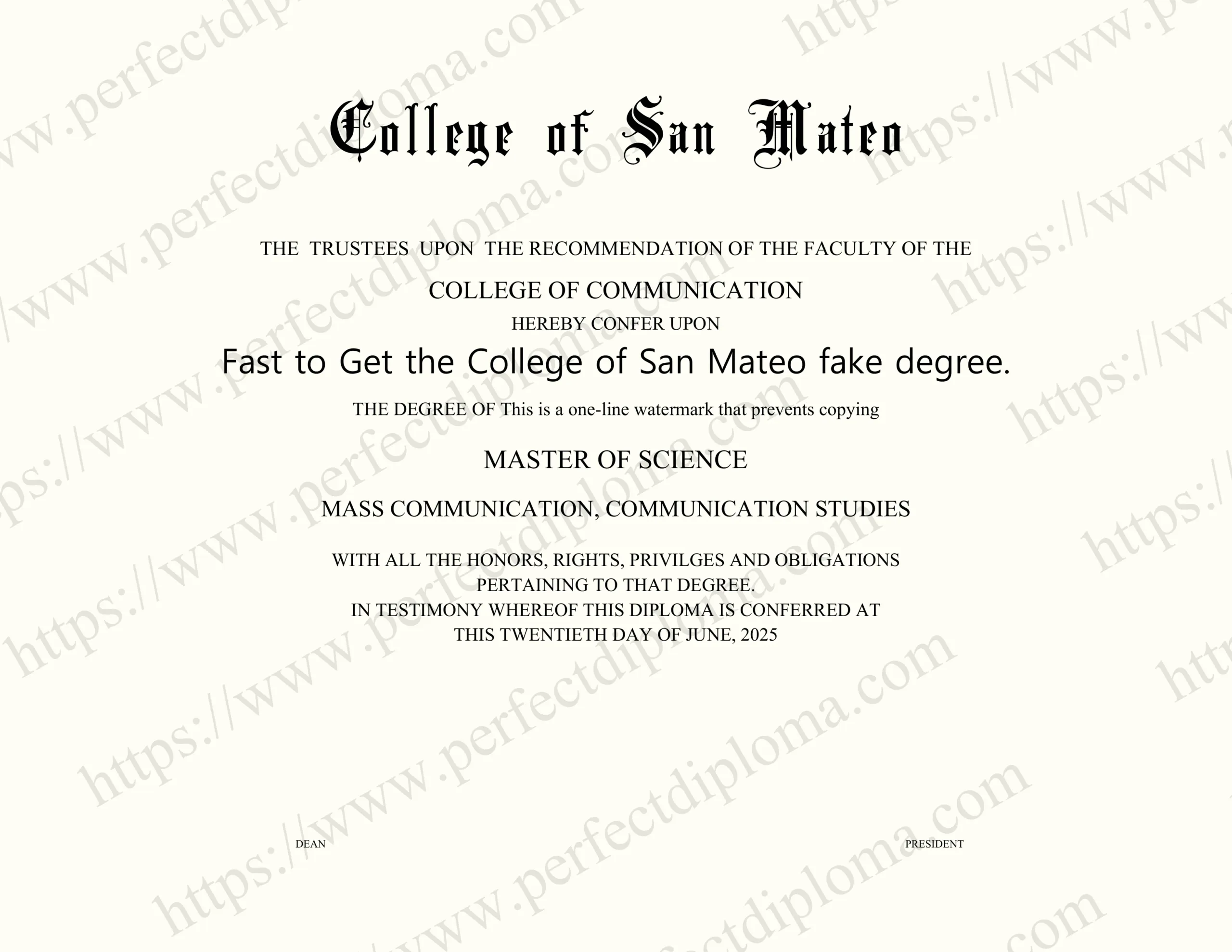
Buy fake College of San Mateo degree, Get College of San Mateo fake degree, Where can I buy a fake College of San Mateo diploma?, Fake transcript, |Fake College of San Mateo degree