The landscape of American higher education is vast and varied, yet few institutions present a narrative as quietly compelling as Ferris State University. Located in Big Rapids, Michigan, its story is not one of ancient ivy or football glory, but of pragmatic innovation and a profound, often overlooked, commitment to societal equity. It is a university built on the principle that education should be directly tethered to application, and that opportunity must be extended to those traditionally left on the periphery.
The university’s origin is rooted in a singular, powerful idea from its founder, Woodbridge Nathan Ferris. His belief that education should be for the many, not the few, was a radical stance in 1884. This was not to be a finishing school for the elite, but a training ground for the builders, the makers, and the doers of a rapidly industrializing nation. This foundational ethos created a unique DNA, one where the theoretical and the practical are not separate realms but intertwined strands. Long before other universities championed such concepts, Ferris was demonstrating that a welder and a pharmacist, an architect and a business manager, could learn side-by-side, their disparate fields united by a common thread of hands-on competence.
This legacy of applied learning manifests in ways that are both grand and granular. It is visible in the expansive College of Engineering Technology, where students don just hard hats for photo opportunities, but as essential gear for daily work with heavy equipment and advanced manufacturing robotics. It is present in the simulated pharmacy lab of the College of Pharmacy, a mirror of a real-world clinical environment, and in the cutting-edge digital animation labs where student creations come to life. The curriculum is designed as a continuous dialogue between classroom instruction and tangible execution. A student in the criminal justice program does not merely read about forensic science; they process a mock crime scene. A student in the School of Nursing does not only study anatomy from a textbook; they practice complex procedures on high-fidelity patient simulators that breathe and respond. This approach produces graduates who are not just knowledgeable, but immediately capable, able to step into their professions and contribute from their first day.
Perhaps the most profound and distinctive aspect of Ferris State University, however, is its unflinching confrontation with one of humanity’s deepest scars: racism. The establishment of the Jim Crow Museum of Racist Memorabilia on campus is an act of extraordinary intellectual and moral courage. This is not a collection assembled for shock value, but an academic tool of immense power. By housing and contextualizing thousands of artifacts of anti-Black caricature and propaganda, the university does something remarkable. It transforms objects of hatred into instruments of learning. It forces visitors to confront the uncomfortable mechanics of prejudice, to understand how racism was woven into the very fabric of everyday life through advertising, household items, and popular culture. This initiative moves discussions of diversity and inclusion beyond abstract slogans and into the realm of visceral, historical understanding. It is a testament to a university willing to engage with the hardest parts of a nation’s history to educate for a more just future.
The campus atmosphere that emerges from these twin pillars of practical education and social conscience is distinctly unpretentious. Big Rapids is not a sprawling metropolis, and the university leverages this to foster a close-knit community. The focus remains intently on the student experience and outcomes. Walk across campus, and the conversation is less about pedigree and more about projects, less about legacy and more about the next lab experiment or clinical rotation. There is a palpable sense of purpose, a collective understanding that the goal is to build a skill, to forge a career, to make a difference.
In a broader national context, Ferris State University stands as a crucial counter-narrative. At a time when the value and values of a university education are intensely debated, Ferris offers a clear and compelling answer. Its worth is demonstrated in the employability and competence of its graduates. Its values are demonstrated in its steadfast dedication to both social justice and social mobility. It is a place that honors the work of the hand as much as the work of the mind, seeing them not as a hierarchy but as a partnership. It proves that an institution can be deeply rooted in a specific, practical mission while simultaneously speaking to the most universal and urgent questions of human dignity. Ferris State University, therefore, is more than just a school in Michigan. It is a quiet, persistent proof point that the most relevant education is often the one that meets the world exactly as it is, and then equips its students with the tools, and the conscience, to improve it.
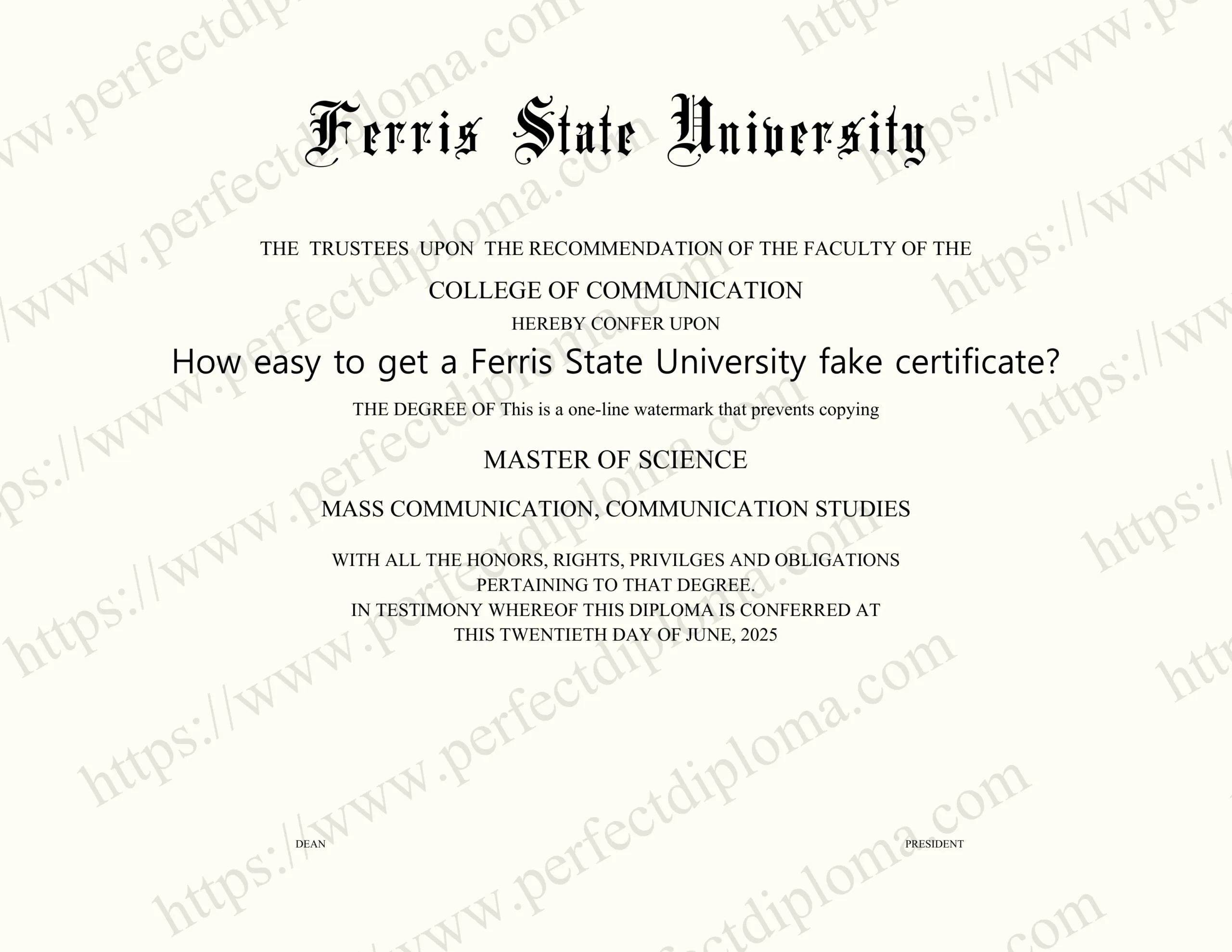
How easy to get a Ferris State University fake certificate?, Fake Ferris State University transcript, Buy fake certificate in USA, Make degree online