New York University stands as a unique institution, not merely within the landscape of American higher education, but as a profound urban experiment. Its identity is inextricably woven into the fabric of Manhattan, rejecting the traditional collegiate model of an isolated, gated campus. This deliberate integration creates a dynamic and often challenging ecosystem where academia and metropolis engage in a continuous, vibrant dialogue. The result is an educational philosophy that is inherently experiential, preparing students not just with knowledge, but with a particular kind of street-smart resilience and global fluency.
The absence of a defining wall or gate is the most potent symbol of NYU’s ethos. The university is the city, and the city is the university. Classrooms are nestled between skyscrapers, student residences overlook Washington Square Park, and the line between a research project and a real-world internship blurs effortlessly. This environment demands a specific type of student—one who is self-motivated, adaptable, and unafraid of complexity. Learning here extends beyond textbooks; it involves navigating the subway system, deciphering the multicultural tapestry of neighborhoods, and finding quiet study spaces amidst the urban hum. This constant immersion fosters a pragmatic, resourceful mindset, turning the challenges of city life into foundational lessons in problem-solving and independence.
Academically, this urban integration manifests in unparalleled access and immediacy. The Tisch School of the Arts draws energy from Broadway and countless galleries. Stern School of Business students analyze Wall Street trends as they happen. Sociology and urban studies departments have the greatest laboratory imaginable spread across five boroughs. Professors are often practicing professionals—artists showing in Chelsea, lawyers arguing in downtown courts, economists consulting for international organizations. This direct pipeline from theory to practice ensures that curricula remain cutting-edge and relevant, offering students a front-row seat to innovation and discourse across countless fields.
Furthermore, NYU has pioneered a visionary model of global interconnectedness. Its degree-granting campuses and academic centers in cities like Abu Dhabi, Shanghai, Accra, and Berlin are not mere study-abroad outposts. They form a networked university, a constellation of urban hubs. A student might begin a research project in New York, continue it with faculty in Prague, and present findings in Sydney. This structure institutionalizes a global perspective, challenging parochial viewpoints and forcing a constant comparative analysis of cultures, policies, and markets. It cultivates citizens who are comfortable operating in transnational contexts, understanding that the most pressing issues—from climate change to public health—demand collaborative, borderless thinking.
However, this distinctive model is not without its tensions. The high cost of existing in Manhattan, coupled with significant tuition, places a substantial financial burden on many students and families. This can create socioeconomic divides within the student body and limit accessibility. The very intensity of the environment, while exhilarating for some, can be overwhelming for others, leading to feelings of isolation within the crowd. The lack of a traditional, self-contained campus community means students must actively build their own support networks, which requires initiative and can sometimes result in a fragmented social experience.
Yet, it is within these tensions that NYU’s character is fully revealed. The university does not promise an idyllic, sheltered college life. Instead, it offers an accelerated engagement with reality in one of the world’s most consequential cities. It produces graduates who are less likely to be surprised by the pace, diversity, and complexity of modern professional life. They have already negotiated it. Their education has been a process of learning to synthesize—to draw connections between a lecture hall discussion and a news headline, between a cultural theory and a performance in the East Village, between a financial model and the economic realities of the surrounding community.
In conclusion, New York University represents a bold reimagining of the university’s role in the 21st century. It is an academic institution that has fully embraced its identity as an urban and global entity. By dissolving the physical and conceptual boundaries between campus and city, and by extending its network across continents, NYU educates through immersion. It prepares individuals not merely for careers, but for intelligent, engaged citizenship in an interconnected world. The degree it confers is more than a certificate of academic completion; it is a testament to a lived experience of navigating, contributing to, and critically understanding the intricate dynamics of global urban centers.
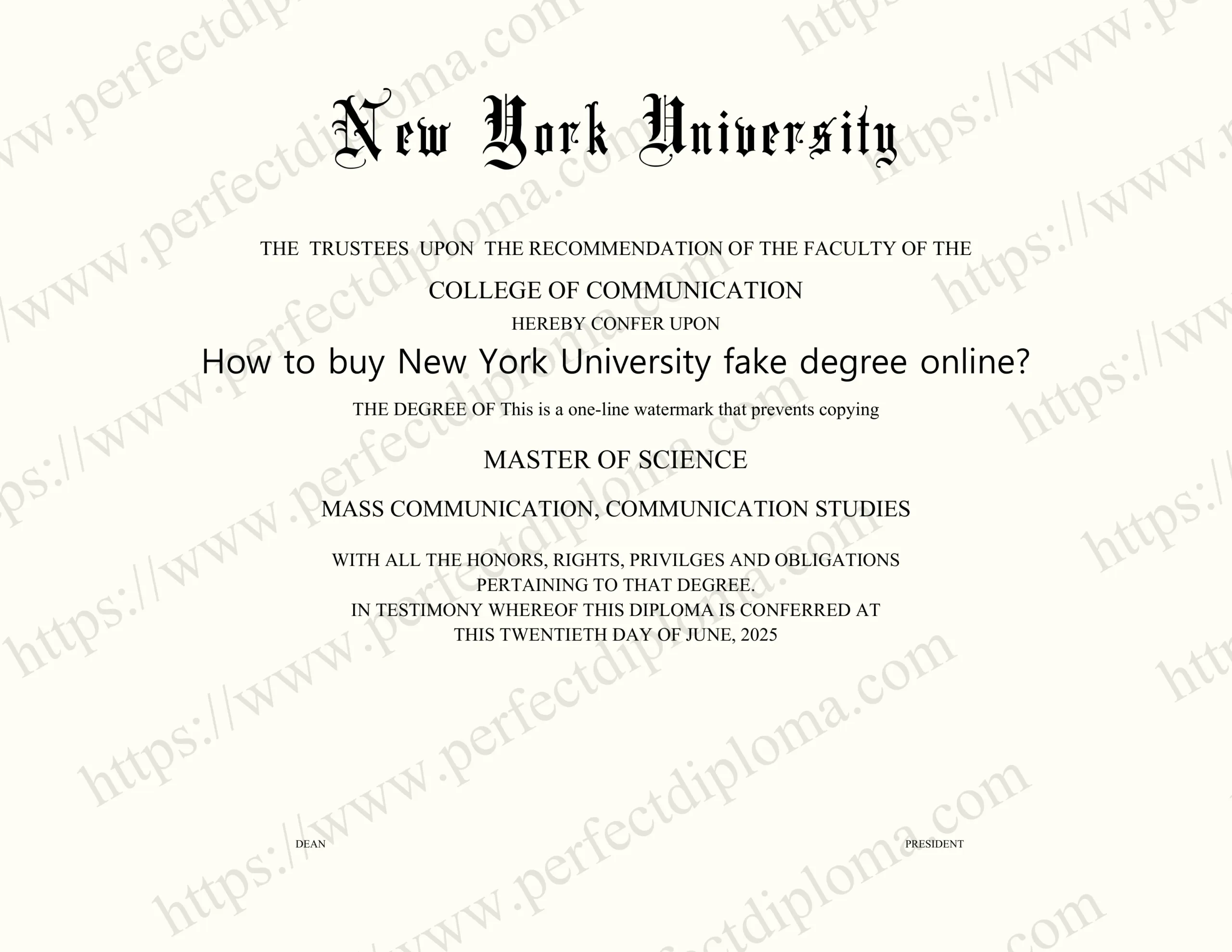
Where can I buy a fake New York University diploma?, Buy fake degree in USA, Steps to order New York University transcript online., Buy fake certificate in USA